
Cyberpunk 2077
Verdict
One of the biggest comebacks in gaming and one of my favourite games ever. Night City is unmatched in density and visual ambition, the cast hit me harder than any plot could and the melee and hacking gameplay is endlessly satisfying - only the shallow lifepath promise and the freedom that never forces you to engage with its best systems hold it back.
What should you know before starting?Edgerunners and Phantom Liberty both build on it.
Pros
- Night City - density, verticality and visual detail no other game matches
- side characters that matter and hurt to leave behind
- melee builds and hacking are incredibly satisfying
- excellent sound design and voice work, especially Johnny and Reed
- Phantom Liberty finally delivers choices that shape the story
Cons
- your lifepath barely changes anything beyond the prologue
- the game's freedom never forces you into its most engaging systems
- braindances never fully click
- V's own story often takes a back seat to the side characters
I have had a difficult history with Cyberpunk 2077. I preordered it when it first came out back in 2020 - jumped in with excitement on release day and immediately got massive whiplash by insane bugs and performance issues all around. I quit and didn’t touch it ever since. Skipping forward 6 years later and after playing through the whole campaign, most of the carefully crafted side missions and the expansion, I can confidently say that Cyberpunk is an immensely fun experience and easily one of my favourite games I have ever played. The way this game manifested into this position for me personally is probably not unlike a lot of other people out there - it remains one of the biggest comebacks for any video game in terms of quality barring maybe only No Man’s Sky.
Cyberpunk in all its glory and without game-breaking glitches and constant crashing compared to its launch-state, feels really fleshed out and actually finished this time around. Everything in it is built towards immersion but that doesn’t matter at all when every few minutes a game breaking weird bug occurs that completely ruins it all. Thankfully nowadays the game has way less of these which means getting way more out of the immersion the devs have built towards. I have had 4 or 5 bugs across 40 hours which is fine, especially considering how ambitious Night City looks.
behind the scenes: laying tracks ahead of a moving train.
Full production on Cyberpunk only really started in 2016, after The Witcher 3’s expansions were done. Along the way the project was rebooted from a third-person RPG into the first-person game that shipped. CDPR built the engine and the game at the same time, and developers compared it to laying tracks ahead of a moving train. Even the 48-minute E3 2018 demo that won over a hundred awards was a separate build made only for the show. Developers reportedly expected the game to need until 2023, but the release was pushed to the 2020 holidays so it could still launch on PS4 and Xbox One before the new consoles.
night city.
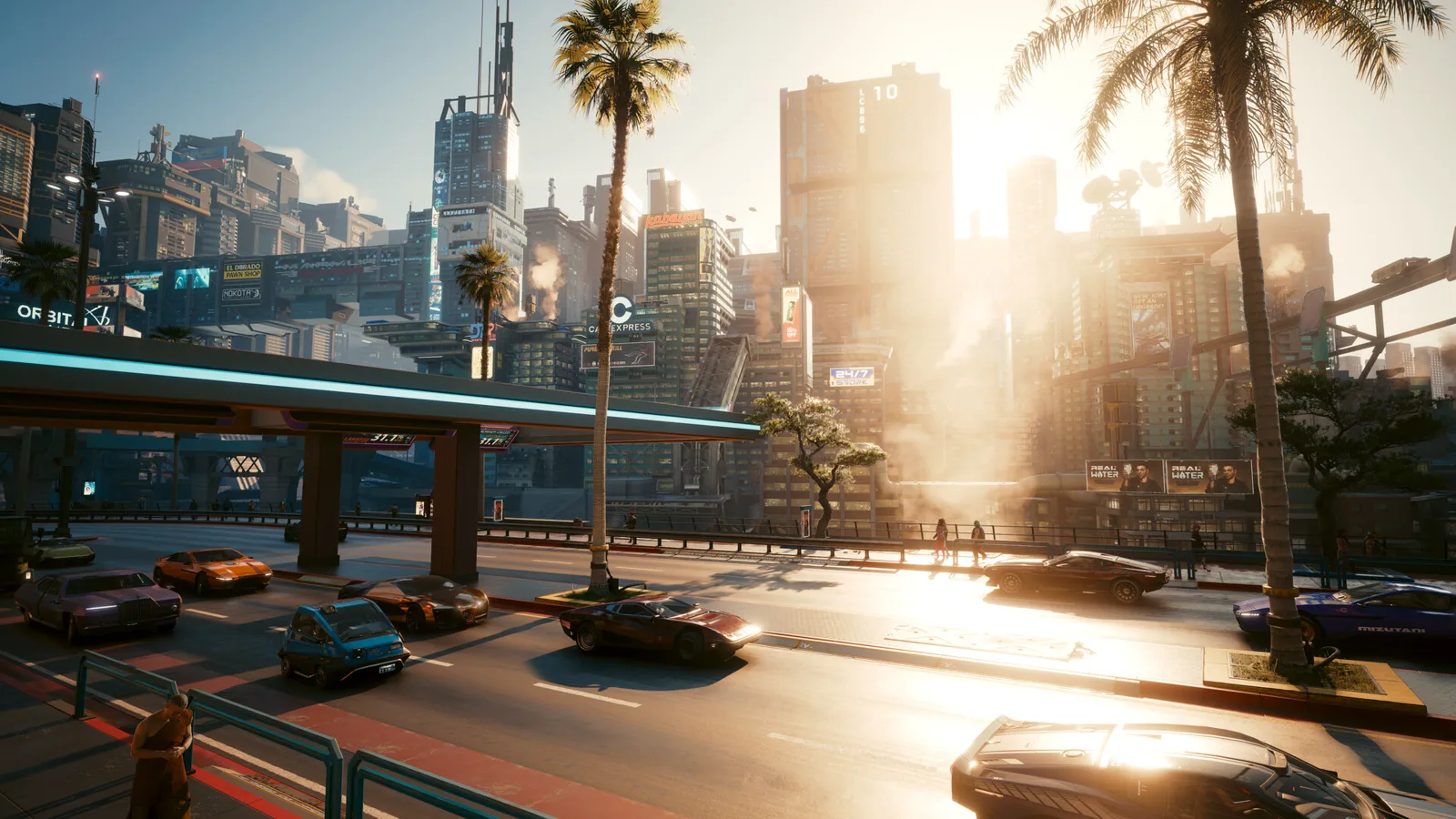
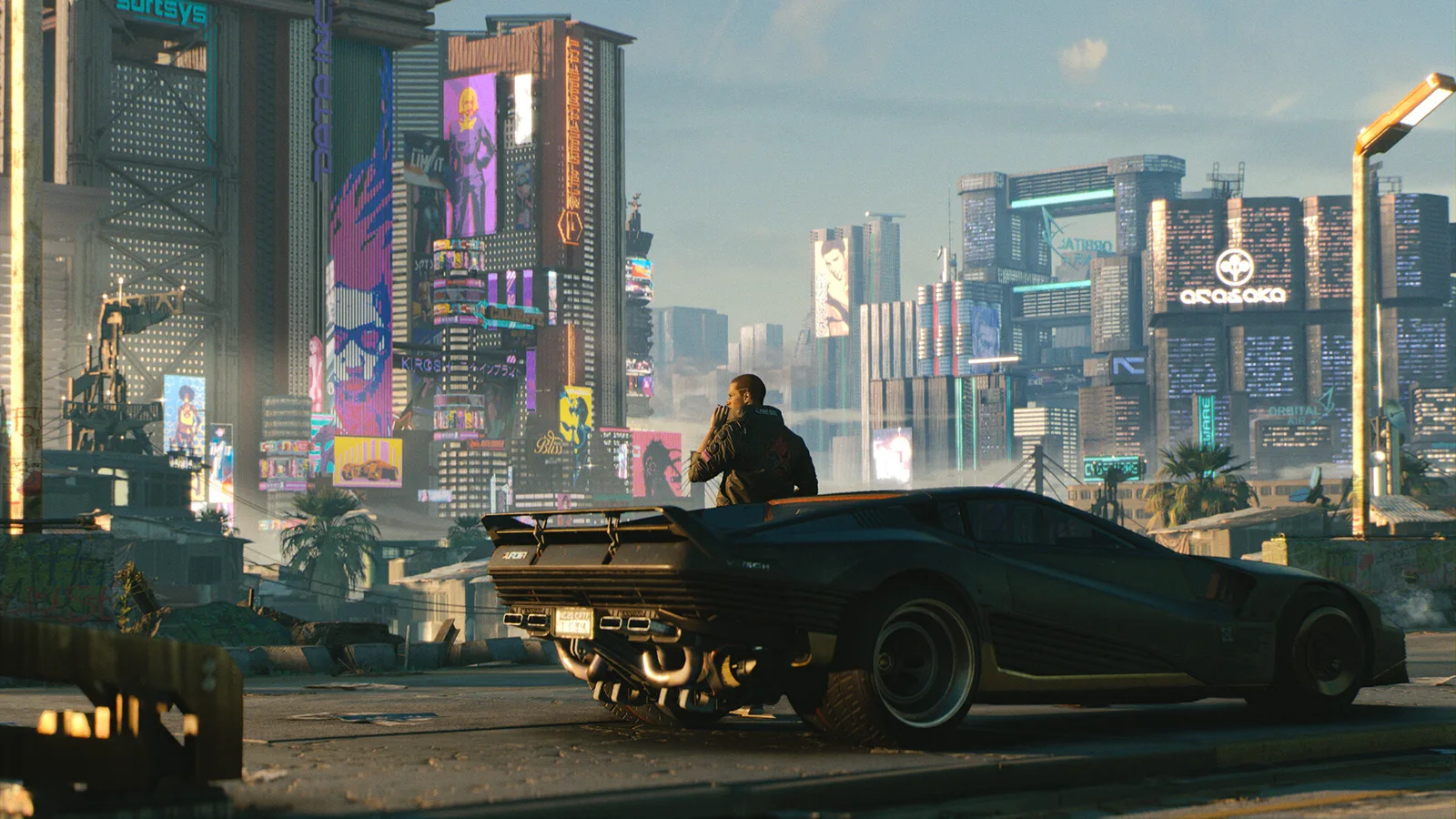
The city - its density and verticality is something that no game before had at this scale while matching the amount of depth and state of the art visual fidelity with an impressive amount of detail no matter where you look for it. I first realized this when setting foot onto a market with giant holographic fishes - this creative approach to visuals is used everywhere in Night City and is getting amplified by an abundant use of colors and realistic lighting. The barren, yellow Badlands are a complete contrast to this and give your eyes a break if the neon city lights get too much.
behind the scenes: where night city comes from.
Night City is inspired by Los Angeles and San Francisco and sits between the two on the in-game map. Its look draws on Blade Runner, Ghost in the Shell and Akira. In the North Oak Columbarium you can even find memorials for Blade Runner’s concept artist Syd Mead and for Rutger Hauer, who played Roy Batty. Phantom Liberty’s Dogtown is based on Las Vegas and Managua. Its market inside an old stadium is modelled on Warsaw’s Stadion Dziesięciolecia, which turned into a huge black-market bazaar in the ‘90s.
lifepaths & story.
I started in those Badlands, choosing my lifepath as a Nomad and not a Streetkid or Corpo. When first starting the game I think everybody hoped that this choice actually significantly shapes the adventure beyond just having different dialogue options at some points. Sadly in this matter you will get disappointed: The only purpose and change this lifepath seems to bring is a different prologue and spawn point. I am not suggesting that CD Projekt Red only included these because they look cool and ambitious when showing off and talking about, but I think when trying to incorporate choices in a deep immersive Action-RPG like this, you should either go close to all-in or restrict it more and tell a more focused story throughout the campaign.
the community: “very meaningful choices”.
The lifepath was the loudest complaint at launch. The top lifepath post on r/cyberpunkgame in December 2020, with over 2,000 upvotes, mocked the marketing line about choices with a huge impact on your story. Nomads got it worst, since the game starts you off as someone who used to be a Nomad. Players and critics agree the three paths merge after about 20 to 30 minutes. The starter villain of each origin never comes back either.
This lifepath approach gives the game its restrictions when it comes to story regarding the main protagonist V: set pieces and story arcs are often consequential for a wide array of side characters but almost never for ourselves - the main character. What helps fight this issue is Johnny, who seems to be trapped in our own body through a chip and we now have to share our whole existence with him. I am glad Keanu Reeves (Johnny Silverhand) is not just a marketing device here but actually a very central part of the game’s story line which makes it all the more interesting even without the direct involvement of V (at least until the final few hours of the story).
behind the scenes: johnny wasn’t written for keanu.
Johnny wasn’t written around Keanu Reeves. CDPR only started looking for an actor when the script was nearly done. One of the directors suggested Reeves because of his history with the genre, and the studio denies the popular theory that the story was rewritten for him in 2018. Reeves came up with Johnny’s walk and gestures himself and recorded for about a month, often two four-hour sessions a day. He also offered to sing Samurai’s songs, but CDPR used Dennis Lyxzén from the punk band Refused instead.
the characters.
What I did not expect is these side characters getting so important to me as the player. I genuinely felt dread and loneliness when the epilogue played and the plot of the expansion finally gave me what I wanted when it comes to choices that shape the story in the first place. For these reasons I forgive the lifepath slip-up and the up-and-down involvement of the main character in the plot and can still undoubtedly say that I enjoyed Cyberpunks story and especially its likeable (or unlikeable) cast of main and side characters a lot.
behind the scenes: built so you never have to.
Most of the character content is optional on purpose. CDPR made the main story shorter on purpose because many players never finished The Witcher 3, so it runs roughly 25 to 30 hours against The Witcher 3’s 45. Everything relationship-related is optional. If you skip it all, the game still lets you finish and routes you to its bleakest ending. Playing only the main quest leaves around 80 percent of the content untouched, including most of what develops V and Johnny.
gameplay.
In terms of gameplay this game has certainly a lot to offer - you can play it like a simple first-person shooter, you can play it like a stealth game and sometimes you can even try to talk your way around unwanted confrontations. Braindances serve as the detective part of the game finding out new information based on VR-environments that can be analyzed on sound, temperature and visual dimensions. At first these didn’t really click for me but once you are at your third braindance you kinda get into the flow of them, sadly I never really was excited when one came around. They sorta felt like a feature of the game that could have been something more but somehow the final ambitious sauce is missing. Contrasting this feeling completely is my opinion on the variety of weapon and melee builds and hacking gameplay of cyberpunk - these two things are easily my favourite part of cyberpunks gameplay loop. There are lots and lots of different guns - some even being able to shoot around walls or autolocking on enemies. Your character can be modified with different kind of perks and upgrades but the one thing that stands out here the most are the melee builds - you can amplify your own strength by turning into a living weapon and gaining gorilla arms or mantis blades and slicing through your enemies - easily the most satisfying thing you can do in the game. But the crown jewel of cyberpunks gameplay is the hacking - you can do so much with it - stun enemies, make them blind, open doors, manipulate cameras and turrets… it all sounds absolutely incredible, because it is - there’s nothing wrong with having lots of options - but with cyberpunks immense freedom approach to gameplay design none of these are ever required by the player which I honestly wish CD Projekt Red tried to do. I wish I was forced to hack me through a high surveillance corporate skyscraper a la watch dogs, or a harbor heavily guarded with conveniently hackable turrets taking out my opponents. But most of the time my approach to any start of a restricted area stayed the same: starting out with stealth as long as it works out and switching to full warfare guerilla style the moment I fuck up - it’s a very personal critique but something that is very much important to me because I value engaging game design over mindless freedom.
behind the scenes: braindances worked a little too well.
The braindance headset is modelled on a real diagnostic device that triggers seizures in a controlled setting. At launch the game copied that a little too well. Its flashing sequences caused real seizures, and after an epileptic reviewer had one and warned others, CDPR removed the effect in a hotfix the day after release. For a system the marketing pushed so hard, the whole game has only six braindances. Two of them sit in a side questline you can skip.
sound design.
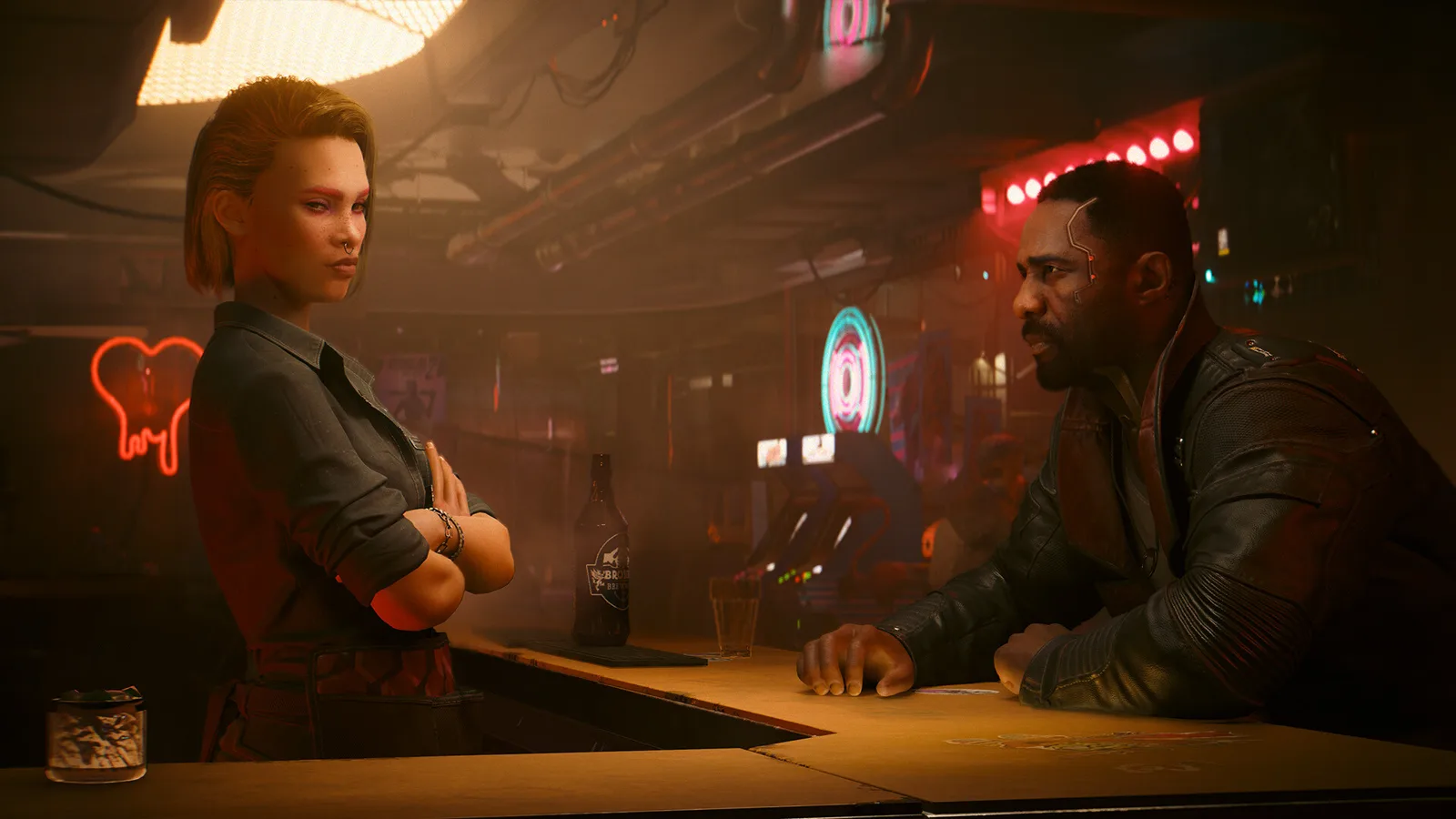
When it comes to the sound design of cyberpunk - this is again one of its strongest points, be it the radio stations music, the sounds of the guns or the atmosphere of the packed city squares or the empty silence when looking down at the city lights from a high vantage point. What stands out are the performances of Johnny and especially Reed in the Phantom Liberty expansion, all the voice work is excellent, but it felt like these two are a step above the rest.
behind the scenes: the V who expected to be replaced.
Both voices of V expected to lose the role. Cherami Leigh (female V) recorded a demo for E3 in 2018 and assumed an A-list actor would take over. When Keanu was announced, she was sure she’d be fired, and Gavin Drea (male V) still expected to be replaced six months into recording. V’s first scene with Viktor was Leigh’s audition. Her reaction to Ozob, the clown with a grenade in his face, is real, because she was seeing him for the first time. She later got a BAFTA nomination for the role.
innovation.
CD Projekt Red innovates with Cyberpunk mostly through how far they pushed their own ambition. Night City set a new bar in visual density, verticality and scale. Then again, most of it is great execution of ideas that already existed. The lifepath system is its biggest misstep: it promises a lot and only delivers slightly different dialogue.
what stayed with me.
What stayed with me wasn’t the plot but rather the people I get to know and the cost of losing them. Once those scenes after the last main mission hit - actually talking to the few friends you still havethose few friends that stayed in Night City next to myself - I felt loneliness and a deep sadness within me. A voicemail, an unanswered callJudy’s voicemail, Panam’s unanswered call - these moments hit me way deeper than I could have ever expected them to do. Closing this game the last time felt like a very important lesson I learned throughout the last six years. The fun while playing this game compared to the long wait before that and the melancholic nostalgia I got nearly immediately after finishing the game are incomparable - time really moves fast, when you are having fun.
fan theory: the tower is a goodbye to the player.
A popular reading of The Tower ending: it answers Dex’s question from the start of the game, whether V wants a quiet life or to go out in a blaze of glory. Every other ending is some form of glory. The Tower is the first time you see the quiet life. The two-year time skip also puts V where Johnny was the whole game, waking up after everyone has moved on. The ones who take V’s absence best are Kerry, Rogue and Viktor, the oldest of V’s friends. Judy, Panam and River have moved on with their lives. Some fans also read it as a goodbye to the players themselves, since Phantom Liberty was the last content for the game.
a quiet life, with spoilers.
Spoilers: click to reveal
I felt like Jackie’s death came as one of the biggest surprises for me with it taking place very early on in the game. I felt like CDPR could’ve done way more with him delaying his death a little further into mid-game instead of killing him off so prematurely. With it being what it is I think Jackie’s arc could’ve been a way more hardhitting and emotional character arc that way.
behind the scenes: jackie was never getting more screen time.
The six-month montage after the prologue is often called cut content, but CDPR staff say it was always planned as a montage and never as a playable stretch. The option to call Jackie’s number and leave him voicemails in Act 2 was only added late in development. Until Johnny shows up, even the quest log is written in Jackie’s voice, with blunt quest names like The Heist. After that the log switches to Johnny’s voice and every quest is named after a song.
Screenshots and clips: CD Projekt Red (official trailers, Steam page). Koi: Reddit.