
Kirby and the Forgotten Land
Verdict
A highbar setting entrance for the Kirby franchise into the third dimension, thanks to a greatly contrasted setting, new features I want to always have in the future, and a soundtrack that stays with you. With the only flaws being too few gimmick transformations, a setting that has not been carried through when it comes to world design and a slightly lean campaign length.
Pros
- the post-apocalyptic setting and its contrast with kirby's cheerfulness
- upgradeable copy abilities - the one feature every future kirby needs
- consistently great soundtrack across completely different genres
- a post-game that remixes every world with a new dreamlike look
Cons
- only ~10 truly gameplay altering transformations
- half the worlds don't commit to the abandoned setting
- challenge rooms all look the same
- a slightly lean campaign, only around 5 main levels per world
The first mainline 3D Kirby game introduces some great ideas but underuses them.
the setting and its worlds.
Perhaps unsurprisingly my favourite parts of this game are its setting and the environments HAL built within that setting without ever deviating from it. Whoever had the idea of making a Kirby game set in an abandoned post-apocalyptic world should get a raise - it is the biggest and most positive design decision made for this project thanks to the striking contrast between the cheerfulness of kirby and the setting of abandonment and loneliness. The new gimmick is kirby being able to transform into human-made objects - a gimmick that was built around the setting of the game - or more probably the other way around.
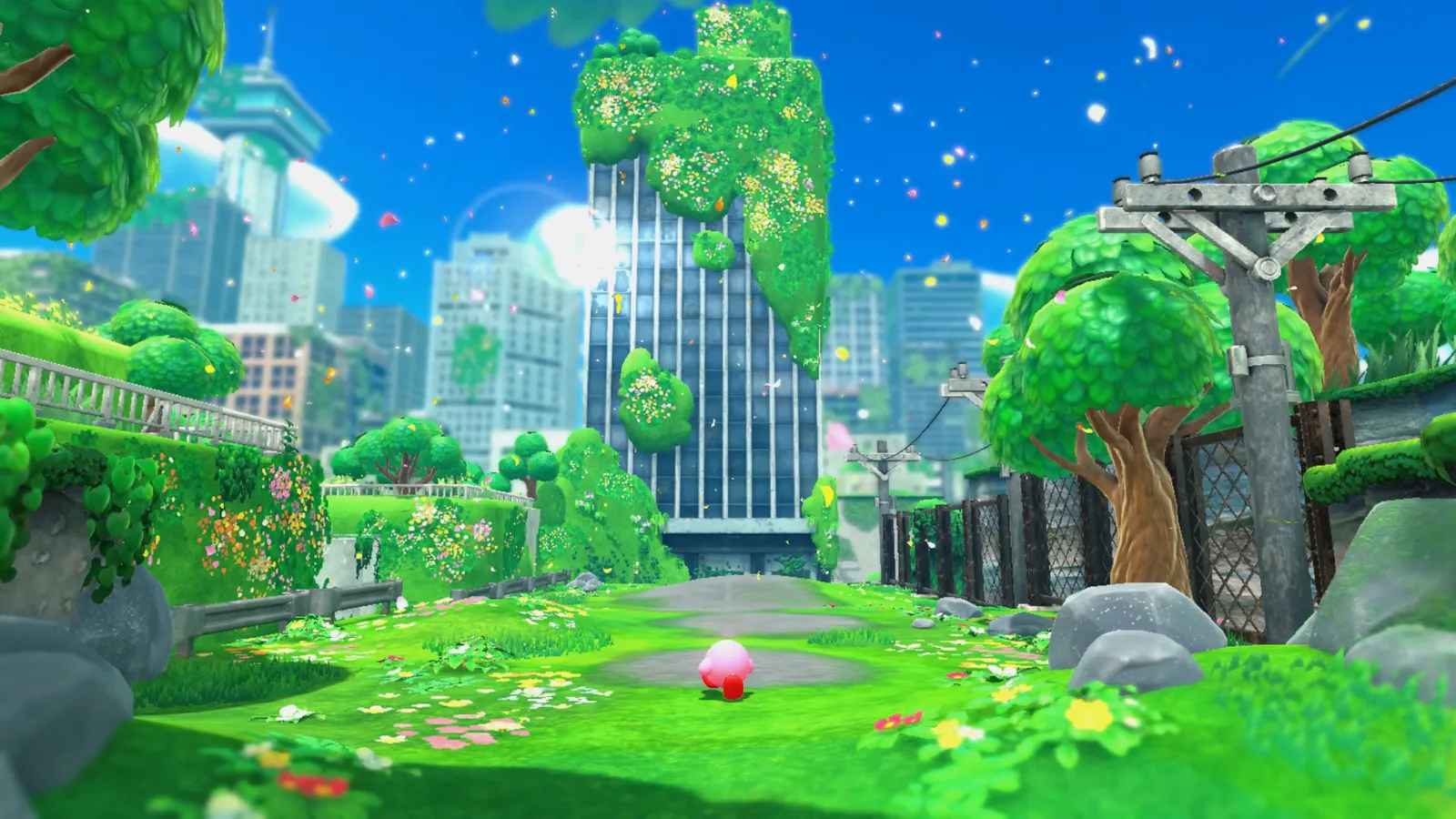
trivia: the ruins are signed.
The signs all over the ruins are English, written in a made-up alphabet. Fans cracked it from the trailers before the game was even out. The three big companies of the vanished world, Holine, Alivel and Lightron, spell out HAL. The first letters of the worlds spell NEW WORLD. Every clock in the game is stopped at 4:27, a nod to 27 April 1992, when the very first Kirby came out in Japan.
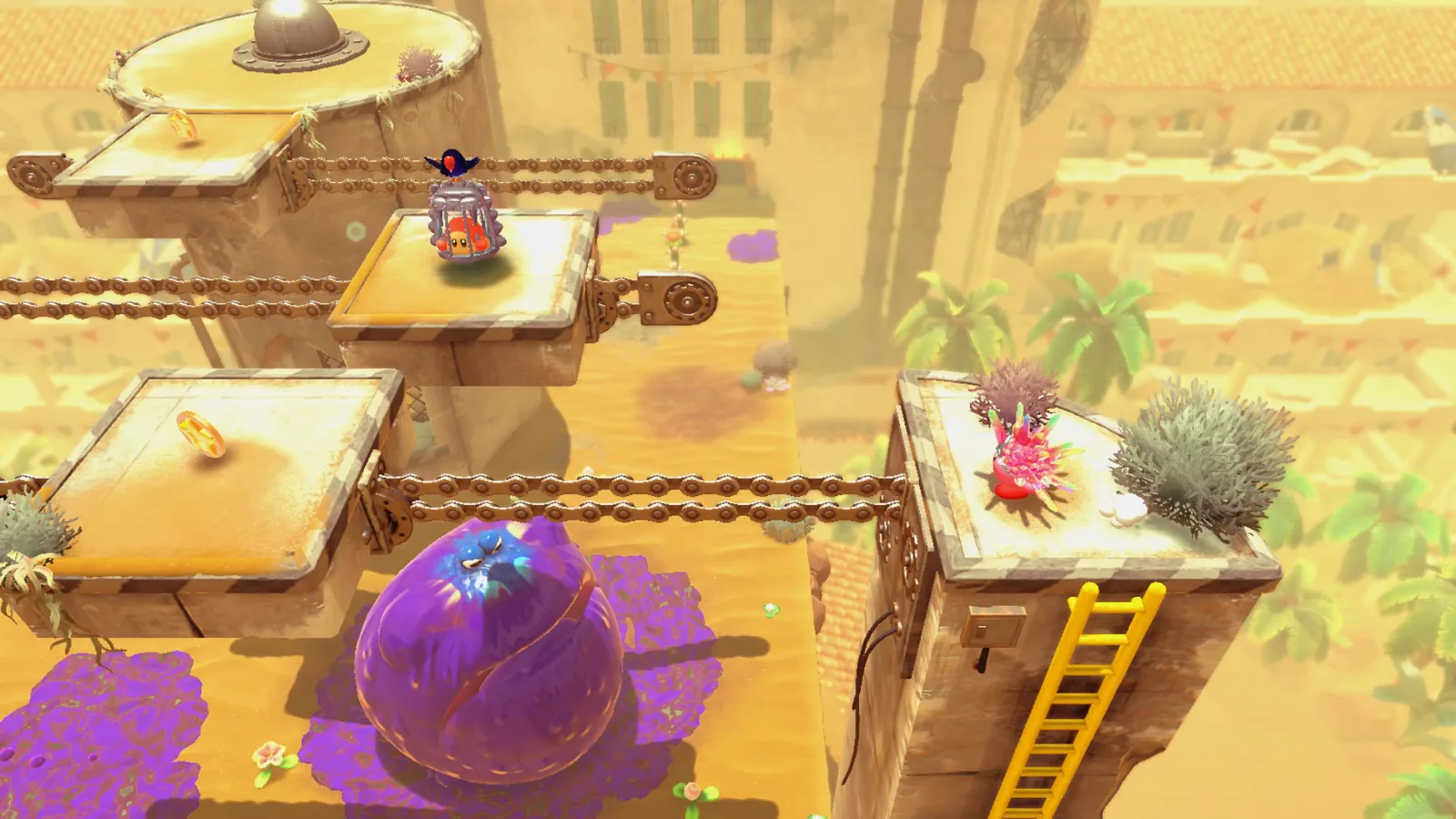
For example there are desert, lava and ice worlds. They are technically ruins as well, but their environments take over so much that the abandoned civilization barely comes through, making them less exciting to explore after an abandoned city or an amusement park. I feel like worlds that are themed around humanity-created environments would have hit much more not only because it would have fitted the game’s overall setting more but also because it is just more exciting exploring abandoned worlds instead of untouched ones.
behind the scenes: every world is its own apocalypse.
The developers wanted ruins that show the prosperity and joy of what once was, a place that has merged with nature. Each world is built around a different kind of ending. Everbay Coast is a flooded industrial port, Winter Horns a frozen city and Redgar a city slowly swallowed by a volcano. The desert, Originull Wasteland, is a dried-up seabed with a resort town: the cacti are dead coral, and there are anchors, empty pools and a stranded ship. Its first stage is even called The Wastes Where Life Began.
There are 8 worlds including the post game - each one is visually very distinct from one another but all are trying to fit into that same abandoned setting. Some do this effortlessly, like an abandoned Amusement Park that personally reminded me a lot of Nier Automata’s Amusement Park - perhaps because that game’s setting was similar to this, but other worlds did not fit in as well - in general I felt like the setting was made up before actually designing the worlds because half of them did not really have anything to do with it anymore sadly so.
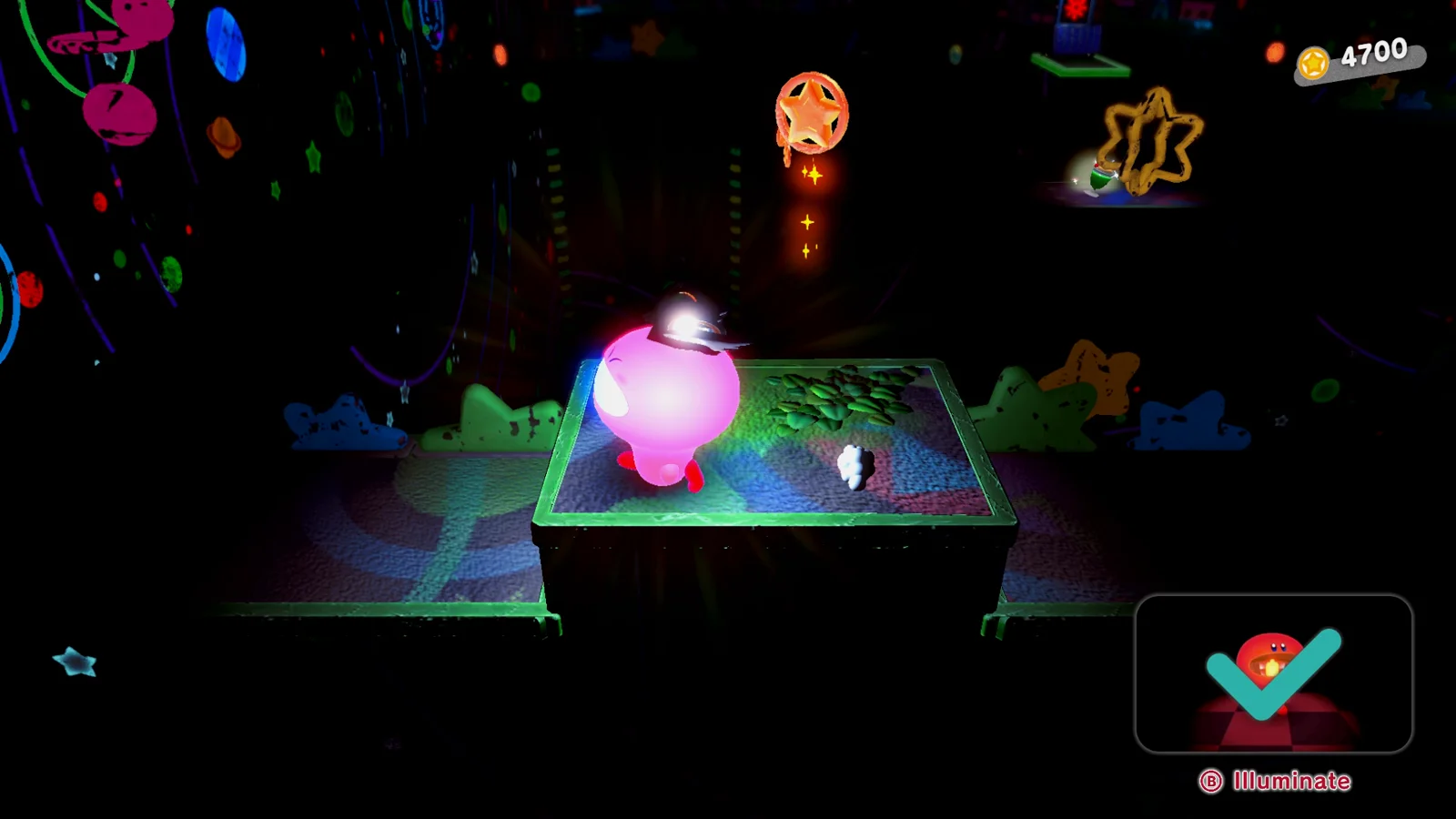
This is also the reason why my favourite worlds are the grass one (World 1) and the amusement park (World 3) because these were the only worlds that unkompromissbar stuck to the game’s overarching setting within themselves (and because World 3 has the best level in the entire game that flexes the game’s lighting). The desert one (World 5) is also up there, but not because of its setting but rather because of game design decisions almost completely unique to that world and iterating through that uniqueness for every level. What I mean by this are unique camera angles, experimentation with more open level design which both came as welcome changes. The ice and lava worlds are my least favourite worlds in the game for different reasons: Winter Horns had too little variety in environmental design throughout its levels which subsequently means this is the world that I will remember the shortest, the lava world was a step up in scale which helped the game’s length but it does so by padding its last two levels into rather generic boss rushes.
trivia: wondaria was a storybook.
According to its in-game figure descriptions, Wondaria was themed after a popular children’s book series of the vanished world about egg-shaped dogs having adventures in space. That’s why its haunted house is set in space, with alien cutouts that laugh with the Boos’ laugh from Luigi’s Mansion. The night parade is a homage to Disneyland’s Main Street Electrical Parade. The changing light has a reason too, since the main story runs over roughly two days and Wondaria moves from late afternoon into the night.
visuals.
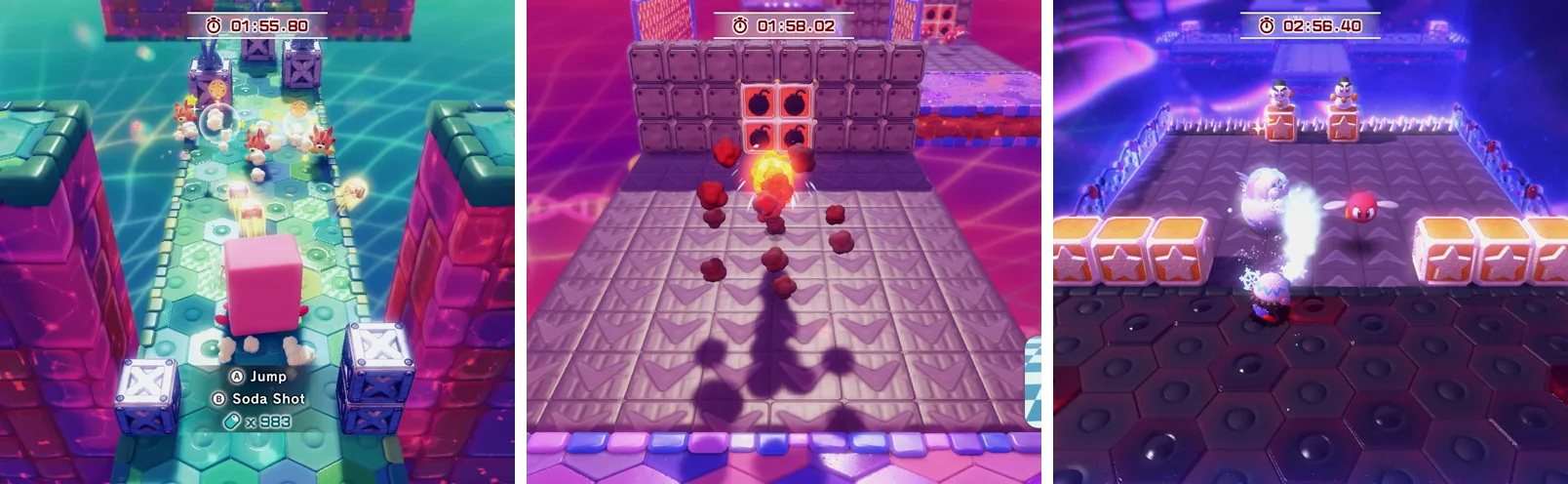
Graphically, the game looks very impressive especially considering it’s on switch 1, one visual flaw is the challenge rooms. Splintered throughout the worlds in between the main levels are these short bonus stages that you can often times finish in under a minute each asking to conquer it in a specific transformation. Gameplay wise an awesome addition but visually they all looked the same and there was no effort in trying to build these into the worlds’ environments they were placed in - I would have loved that.
the sound.
Perhaps unsurprising looking back, but I was hyped by the music this game threw at me. Sound in general is the most consistently great part of it and it even does so across lots of different genres and atmospheres. We start off with a mysterious melodic tone in World 1, across a creatively composed Haunted House track that was totally unique and stands on its own over an atmospheric lava soundtrack, and closing out with final boss osts that are made to be added to my playlists!
behind the scenes: the singer who doesn’t exist.
The vocal theme “Welcome to the New World!”, first heard from a radio in the opening stage, is sung in a made-up language. Director Shinya Kumazaki says it’s an in-world hit by NEICHEL, a famous diva of the vanished world. In real life it’s sung by the J-pop artist Sammy, who performed it in character at the Kirby 30th Anniversary Music Fest under a big hat that hid her eyes. Its melody runs through more than 30 tracks of the soundtrack, from the hub town to the final boss and the credits.
combat & difficulty.
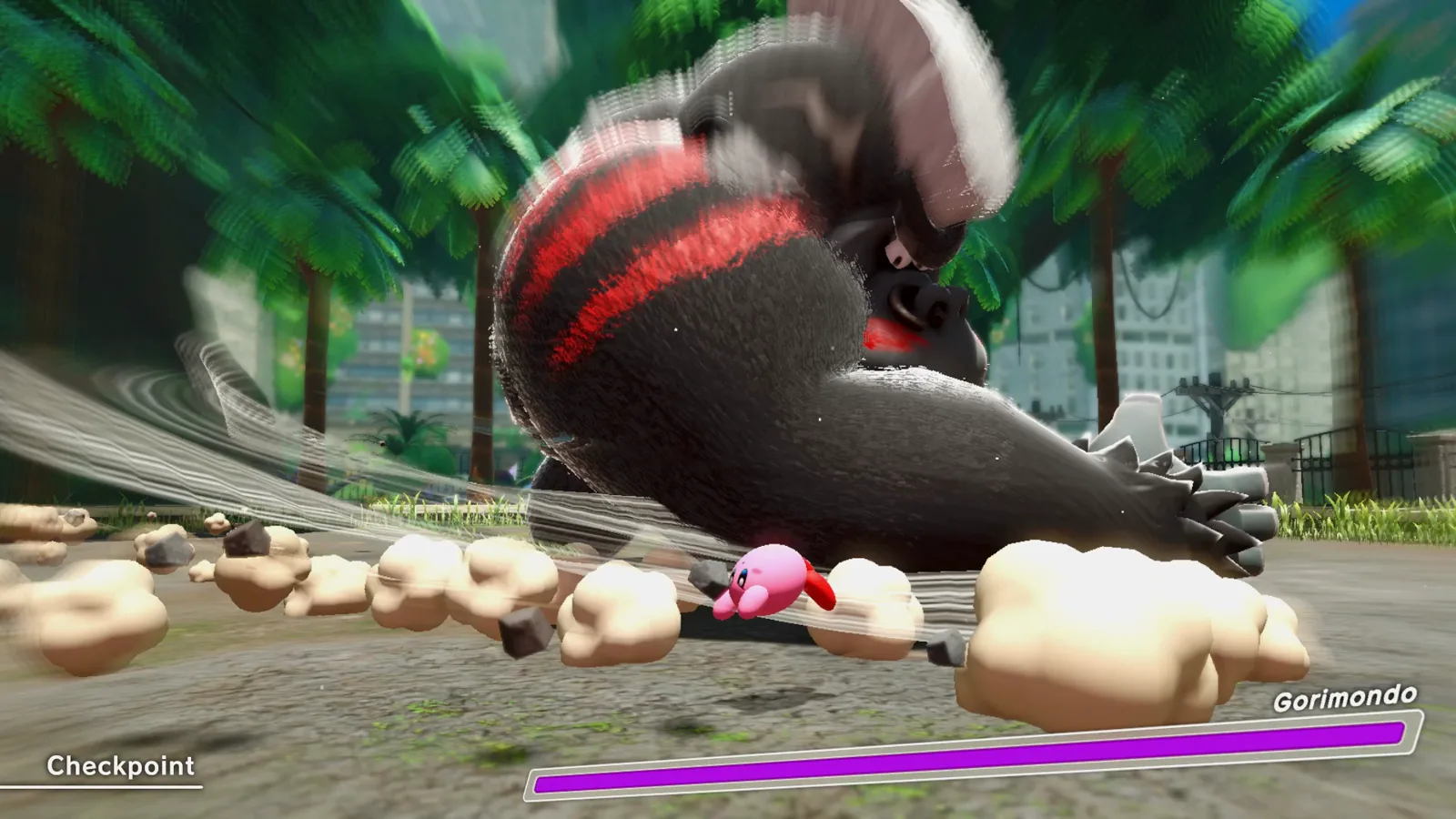
Boss encounters were initially slow and clunky, thanks to me not knowing there was a dodge mechanic by pushing block + in a direction, a realization I have only noticed at World 5. With the dodge - combat was sufficient for a kirby game like this, dodging is easy and satisfying and elevates the combat from being awkward to having a rhythm and flow to it.
the community: the dodge nobody explains.
Plenty of players found the dodge late. The game explains guarding but reportedly never mentions the perfect dodge, and some players on r/kirby only found it in the post-game. Once found, it’s widely called the game’s biggest game-breaker: a last-second dodge triggers slow motion, counters hit harder and in the challenge stages it even slows the timer. Fans dubbed it “Witch Time” after Bayonetta. The demo landed a month after Elden Ring, so “Kirby Souls” memes followed quickly.
In general difficulty was what you would expect out of a kirby game: really easy, even on Wild mode, which essentially is the game’s “Normal” difficulty, with some tougher challenges at the very end of the post game. What I would love for these 3D Kirby games in the future regarding their difficulty is more variety in the type of difficulty the player is facing, all the tough challenges in this game are rooted in combat and boss encounters, but the game features much more than that, platforming (that admittedly is never hard in kirby games by nature), level design itself as well as the transformations, all these gameplay facets deliver opportunities for incorporating different types of difficulty but they are barely taken. Falling barely matters in this game: pits don’t kill you, they just cost a bit of health, but that just means you have to come up with a separate difficulty parameter in platforming that does not revolve around kirby falling into the abyss, often times this type of critique means introducing new gameplay elements resolves it, but in this case it is different: because the new gimmick of being able to transform into household objects exactly addresses this critique by limiting or altering kirby’s movement in new ways - I just wish it was utilized more often and in more ways with even more different transformations. There are only like 10 or so of these truly gameplay altering transformations and I think doubling that number would have done this game very good not only in terms of difficulty variety.
transformations.
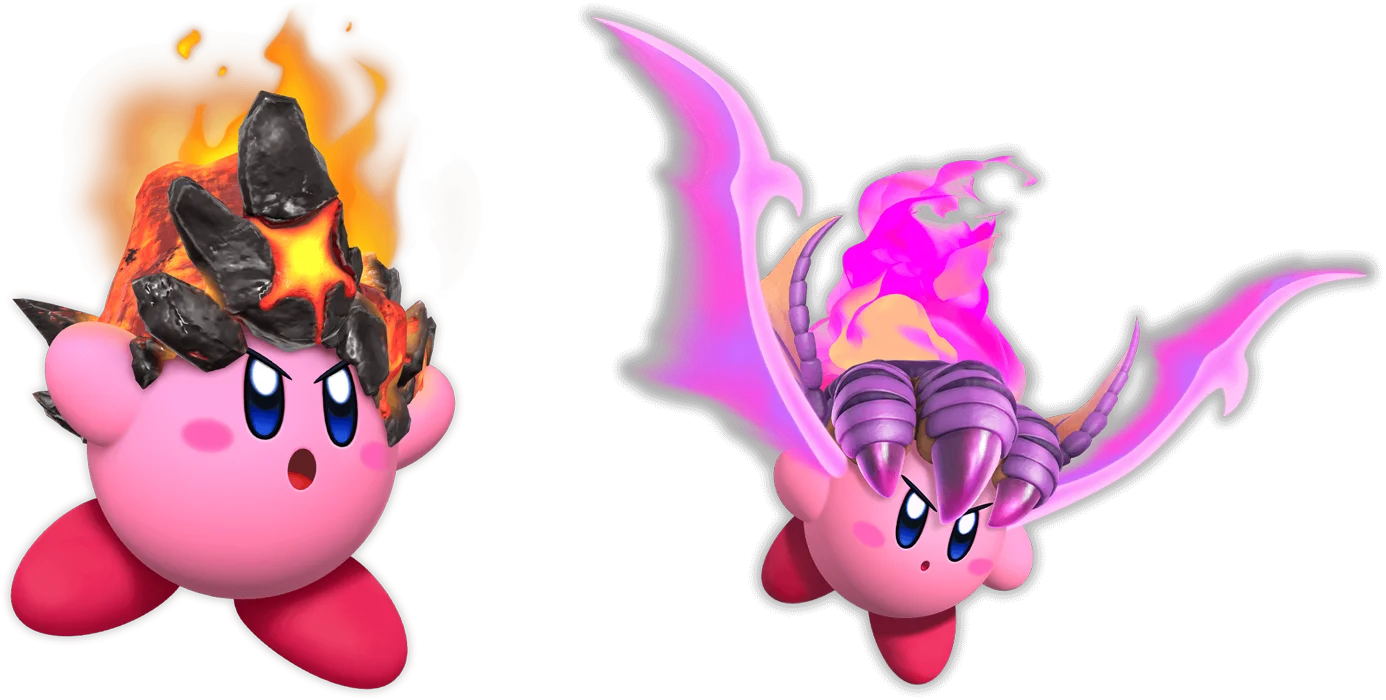
Writing of transformations: obviously the usual kirby abilities are back in this game. Some are cut that were in previous games but the main ones are all there and with them a new feature that I loved: being able to upgrade your abilities. Some of them not only twice but thrice. These upgrades all come with cool new names and a different design for kirby and they are all so good and creative, every time I found a blueprint for a new upgrade and had enough coins and challenge rooms completed I was genuinely hyped to go and find out how the new upgraded ability would look, how powerful it would be and what its new unique powers would entail. If I had to pick one thing that this game brought into the kirby franchise to carry over into the next game: it would be upgrading your abilities.
behind the scenes: old abilities in new hats.
The developers considered bringing back the Animal ability from Squeak Squad but dropped it. With a villain army made entirely of animals, players would have expected every Beast Pack enemy to give it, so its digging went into the new Drill ability instead. Several cut regulars live on as Mouthful Modes: Car Mouth does Wheel’s job, Cone Mouth does Stone’s ground pound and Water-Balloon Mouth covers Water. Kirby was also meant to change colour with every ability and upgrade. That feature still works in the game files.
performance.
Performance was alright - it occasionally dipped below 30 fps but it was never unplayable. No game-breaking bugs or glitches beyond that.
story & characters.
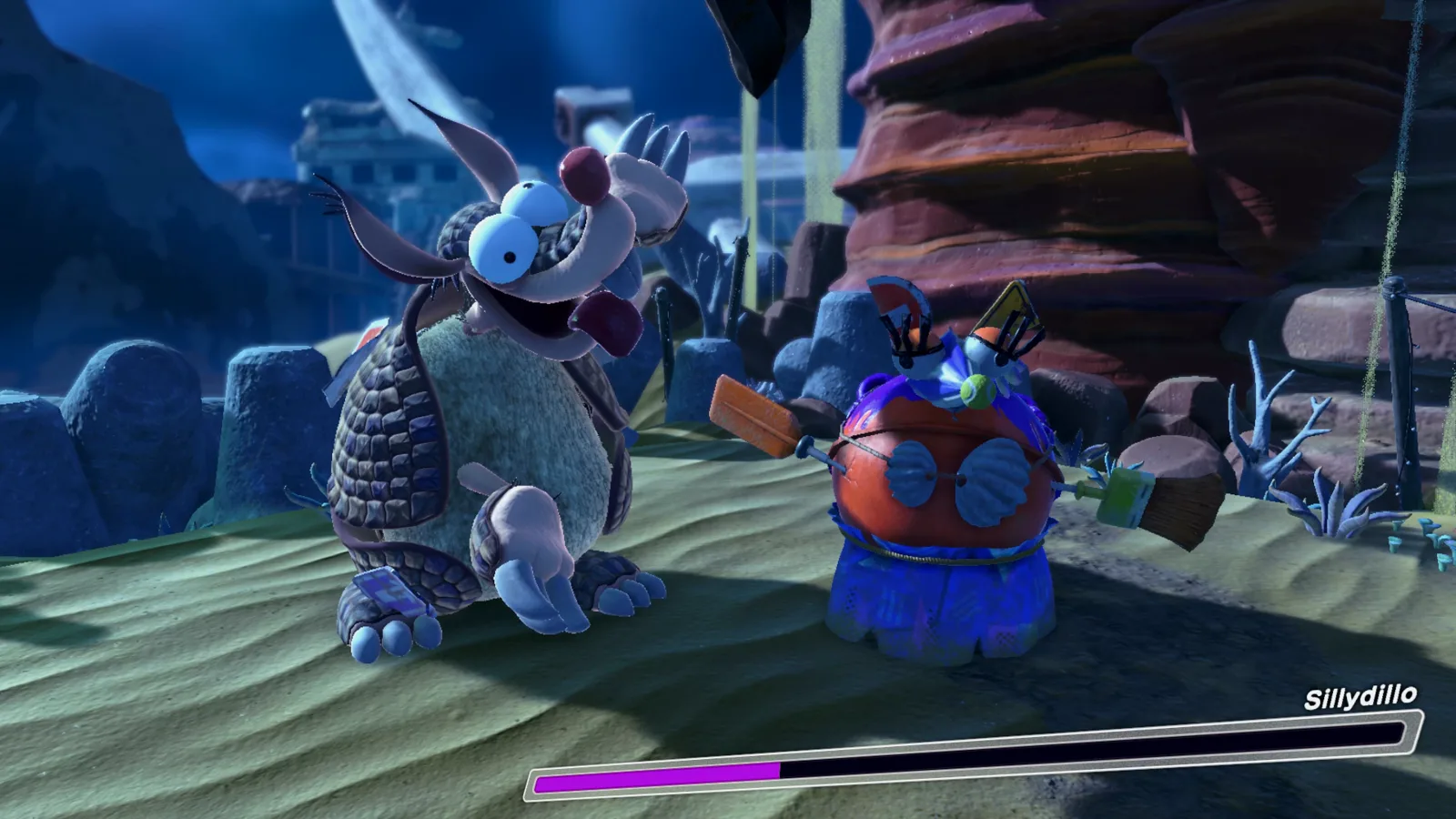
My favourite character design has to go to Sillydillo which is genius, creative and directly woven into its attacks and environment as well. The endgame bossesThe final boss Fecto Elfilis, which is Elfilin fused back into the creature he once broke off from, and the secret final boss Morpho Knight also have to be mentioned as the highlights here. Unsurprisingly these characters and their presentation consistently outperform the narrative itself - a narrative that is, like so often in Nintendo games, a means to an end, a framework in order to have an excuse to deliver memorable boss encounters, creative ideas and most importantly so allows for the setting to make sense in the first place - the reason why the game’s story is mediocre, yet delivers on this front as well.
fan theory: where did everyone go.
The game never shows the people who built the ruins. There are no mannequins in the mall and no drivers in the car ads, only a stylised astronaut cutout in Wondaria. The inhabitants are only said to have left for “a land of dreams”, which English-speaking fans read as Dream Land. That pun only works in English, since Kirby’s home is called Pupupu Land in Japanese. A Japanese figure description says their planet had “become too small”. On r/kirby, opinions split between humans, because of the architecture and the language, and bean-shaped humanoids like that astronaut cutout. A popular theory even makes the Waddle Dees their descendants.
the postgame.
Postgame: It was great: One additional world that has a level for each previous world and remixes the best parts of the world including a harder version of the main bosses at the end of the levels. It also gives them a new dreamlike look that’s very stylish. It tasks you to collect 300 soul fragments across the six levels - 250 are required to reach the game’s Secret Final Boss, which is the hardest challenge of the game, barring the Ultimate Cup Z tournament. The thematic decision to remake the worlds’ color palettes was a cheap one but it is very effective and the core reason of why I enjoyed this Postgame world as much as I did (next to the absolute banger of a soundtrack that plays while doing so).
trivia: and here we are.
The cheerful tour announcer in the last world is the first human voice acting in a mainline Kirby game. It even switches to the language your system runs in. In the post-game the voice comes back broken. The final area’s track loops a distorted “And here we are!” over and over. It returns once more in the hardest fight of the post-game, whose black-hole attack is literally called “And here we are!”. Fans read it as decades of that tour loop having driven the creature mad.
I definitely think this won’t be the last 3D kirby we will get and am very much looking forward to having this franchise now get 3D entries as well regularly (hopefully with upgradeable transformations). Now if you would excuse me I gotta jam out to the final boss ost of this. Thanks for reading!
behind the scenes: eleven years to go 3d.
A fully 3D mainline Kirby was already pitched while HAL made Return to Dream Land for the Wii in 2011. It was rejected as too hard to pull off at the time. A failed 3D leap could have sunk the series, so HAL tested the waters with small 3D spin-offs first: Kirby 3D Rumble inside Planet Robobot, Kirby’s Blowout Blast and Kirby Battle Royale. It then spent another four to five years building on what those taught it.
Images: HAL Laboratory / Nintendo (in-game screenshots and artwork via WiKirby).